
/Product8 min read
Tavily vs. Exa vs. Parallel vs. Firecrawl vs. Perplexity vs. Brave: Choosing the Right Web Search API for Each Use Case
Compare Tavily, Exa, Parallel, Firecrawl, Perplexity, and Brave and see how each approaches web search for AI agents. Explore their strengths, tradeoffs, and ideal use cases, plus what to evaluate when choosing a web search API for your application.

Saying your AI agent needs access to the web is only part of the equation. It doesn't tell anyone whether it needs to find semantically related content, monitor a known website, conduct multi-step research, generate a cited answer, or retrieve current information for another model to reason over.
Although many web search APIs offer overlapping features, they're often designed around different parts of this process. So, how do you choose the right one for your agent?
Even though Tavily, Exa, Parallel, Firecrawl, Perplexity, and Brave are often lumped together as equal options, each platform approaches web search from a different starting point.
- Exa emphasizes semantic discovery
- Parallel supports deeper research workflows
- Firecrawl specializes in crawling and extracting websites
- Perplexity combines search with answer generation
- Brave is built more for traditional web search
- Tavily focuses on fast, accurate, and information-dense retrieval for production AI agents
A platform may be the best fit for one application without being the best fit for every application. In this guide, I’ll compare what each product does, where it's strongest, and the tradeoffs to consider when choosing the right web search API for each use case.
How to choose a web search API for AI agents
Before comparing the platforms, define what you need the API to do. Understanding the task, the output your agent needs, and how much of the process you want the platform to control can help you narrow down the options.
Start with the retrieval task
Consider what your agent knows when it begins. A workflow that starts with a known URL needs different capabilities from one that starts with an open-ended question. A quick lookup also requires a different approach than a multi-step research task.
Decide what the API should return
Some APIs return links and snippets, while others provide extracted content or a synthesized answer. The more processing the platform handles, the faster you may be able to start testing because there's less to build yourself.
Compare accuracy, latency, and information density
Speed alone doesn't make a result useful. Consider whether the API returns accurate, relevant information quickly and with enough detail to avoid additional reranking, retries, or model tokens.
Review control, security, and reliability
Look at the available controls for sources, dates, location, language, and content formats. For production applications, also consider protections against prompt injection, PII leakage, and malicious sources, as well as data retention, uptime, and scalability.
Keeping these criteria in mind makes it easier to determine which platform is best suited to the job.
Which web search API is right for your AI agent?
Each platform covers more than one part of the web search process, but they still have different areas of focus. Here’s where each one fits based on the criteria above.
Brave Search API: traditional web search at scale
Brave gives developers access to its independent web index, with options for web, news, image, video, and local search. It’s a strong fit for broad coverage, fast lookups, single-hop queries, and traditional search experiences.
Brave began as a privacy-focused browser company, with an index informed, in part, by opt-in search and browsing signals from its users. As Brave adapts that search infrastructure for LLMs and agents, its broad results may introduce noise or lack the accuracy some production queries require. This can lead to additional filtering, reranking, or retry logic downstream.
The main question is whether you're building a search experience or an agent that needs context it can immediately reason over. Brave is well suited to the former, while a retrieval-focused API may reduce processing for the latter.
Exa: semantic search and specialized discovery
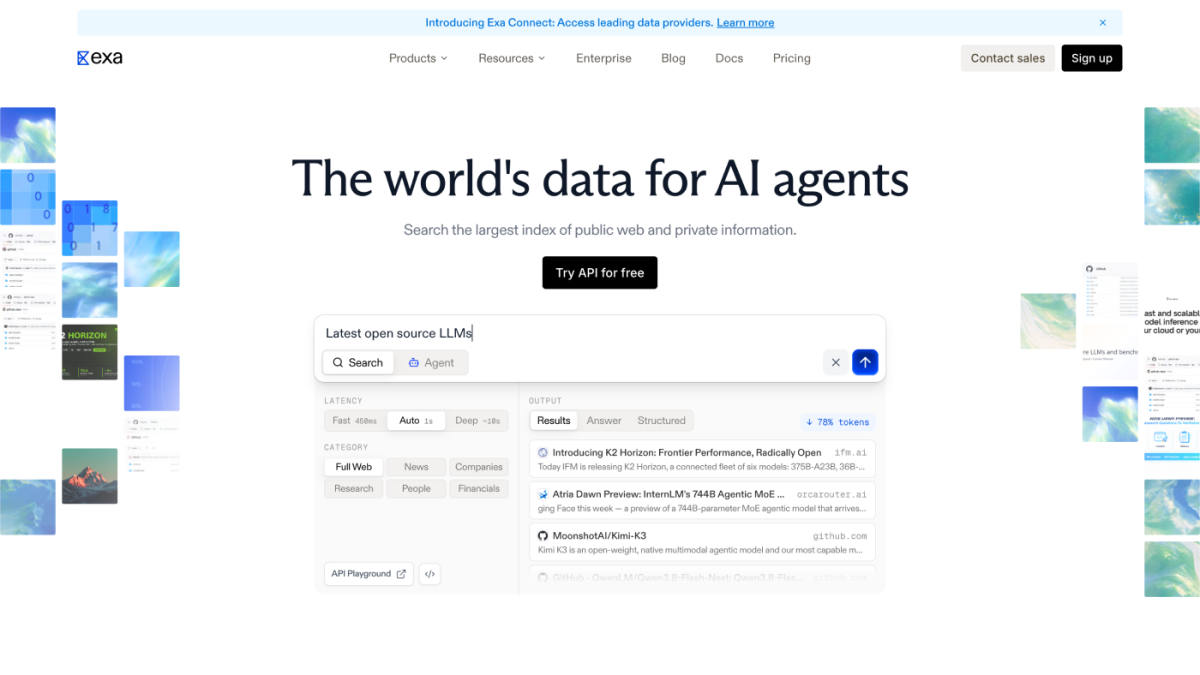
Exa uses neural and semantic search to find content based on the meaning of a query. It’s particularly useful for exploring related concepts and searching specialized datasets for people, companies, research, and other categories.
That semantic strength doesn't guarantee the freshest or most directly relevant evidence for every factual query. Teams building real-time applications should test how consistently the results meet their needs without additional processing.
When semantic discovery or specialized people and company search is central to the application, Exa is a good option. If the priority is fresh, grounded information from across the live web, compare how well its results perform on your real queries.
Firecrawl: website crawling and extraction
Firecrawl is an open-source platform for scraping, crawling, extracting, and monitoring websites. It’s best suited for turning known sites into structured data, including scheduled crawls and notifications when pages change.
Although Firecrawl also offers search, its primary strength begins once you know which websites or URLs you want to explore.
Choose Firecrawl when your application needs to ingest or monitor specific websites. If your agent starts with a question and needs to find the right sources, a search-first retrieval platform may be a better fit.
Parallel: multi-step search and research workflows
Parallel combines search with APIs for research, extraction, monitoring, enrichment, and entity discovery. It’s a strong option when you want the platform to perform more of a multi-step investigation.
Its search modes offer different balances of speed, cost, and depth. Faster modes may return less complete results, while more advanced modes require additional time and cost. Its broader workflow capabilities may also be more than a retrieval-focused application needs.
Parallel is a good choice when you want the platform to conduct more of the research process. If your application already controls the reasoning and orchestration, a focused retrieval layer may offer a cleaner fit.
Perplexity: an integrated AI platform

Perplexity's Search API has become a strong search option for agents and sits alongside Perplexity’s broader APIs for answer generation, models, and agent workflows.
The platform began as a consumer answer product and later extended its search infrastructure into APIs for agents. That breadth offers platform convenience, but teams adopting more of the stack may give Perplexity greater control over how information is retrieved, interpreted, and presented.
Perplexity is a strong choice when you want a capable Search API with the option to bring more of its answer experience into your application. If you want retrieval designed from the start as a modular layer beneath your own models and orchestration, an agent-native retrieval platform may be a better fit.
Tavily: production web retrieval for AI agents
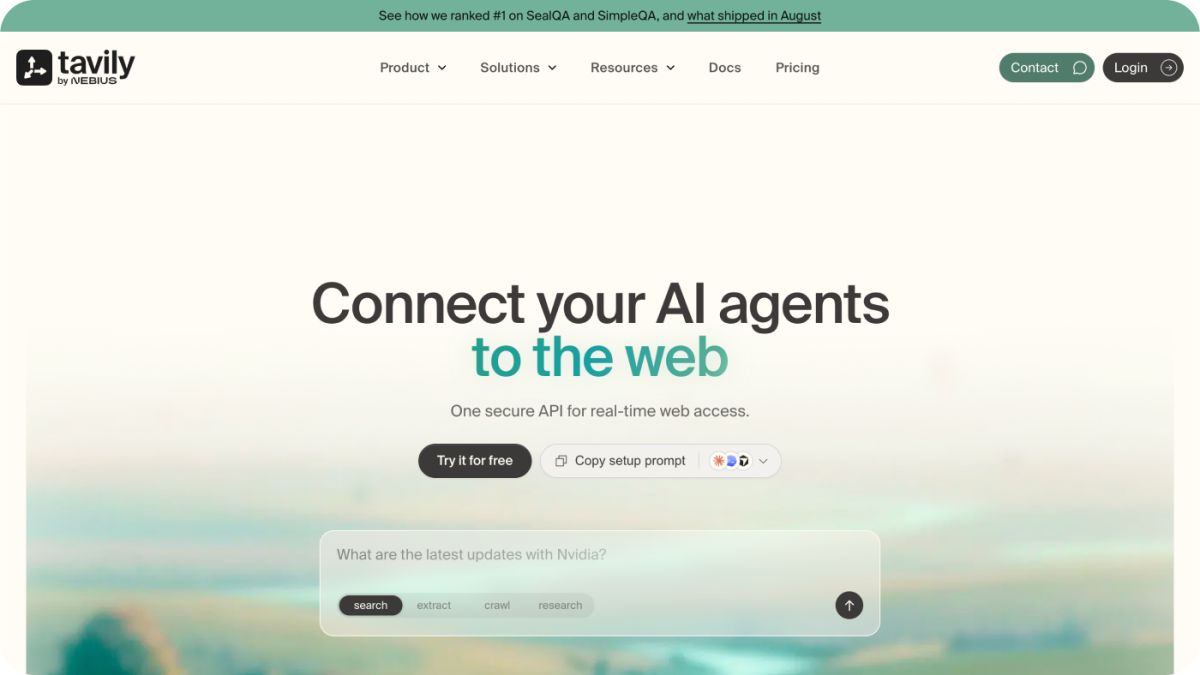
Tavily retrieves, ranks, and extracts current web information for AI agents. It’s built to balance latency, accuracy, and information density, so agents receive useful context without extensive reranking or retry logic.
Tavily prioritizes managed retrieval over self-hosted crawling, a traditional search experience, or a bundled model platform. It pairs that focus with prompt-injection detection, PII and malicious-source protections, SOC 2 Type II, ISO 27001, and zero data retention.
When your product needs fresh, source-backed web context while retaining control over how that information is used, Tavily could be the best fit. If another platform’s specialized workflow is the core requirement, that platform may be a better fit.
How to test web search APIs with your own queries
Benchmarks and feature lists can provide a useful starting point, but they can't tell you how an API will perform in your production application. Build a test set from the queries your agent will actually receive, including simple lookups, real-time questions, niche topics, and more complex research tasks.
Run the same queries through each API you're evaluating using comparable settings for the harness and model. Then look at:
- Accuracy and relevance
- Freshness and source quality
- Citation completeness
- Latency and failure rate
- Information density
- Additional reranking, retries, or model tokens required
The best choice isn't necessarily the platform that wins every query. Look for the one that performs consistently on the queries that matter most to your application and requires the least additional work to produce a useful result.
When comparing costs, include the entire workflow, not just the API request. Extraction, reranking, retries, downstream model usage, and the engineering time required to build and maintain the pipeline can all affect the cost of producing a grounded answer.
Build a web retrieval layer your AI agent can rely on
As AI agents take on more consequential work, web access becomes part of the product’s reasoning architecture. The quality of what an agent retrieves, and how quickly and safely it can use that information, shapes the answers and actions that follow.
Ready to put Tavily to the test? Run your own queries, inspect the returned sources, and see what your agent would receive before integrating the API in the Tavily Playground. You can get started for free.