
/News3 min read
Tavily Ranks #1 on SealQA and SimpleQA
Tavily is now #1 in accuracy on SealQA-Hard, SealQA-0, and SimpleQA after rebuilding core parts of Search, including evidence ranking, contradiction handling, and index coverage. Here's how and why Tavily did it.

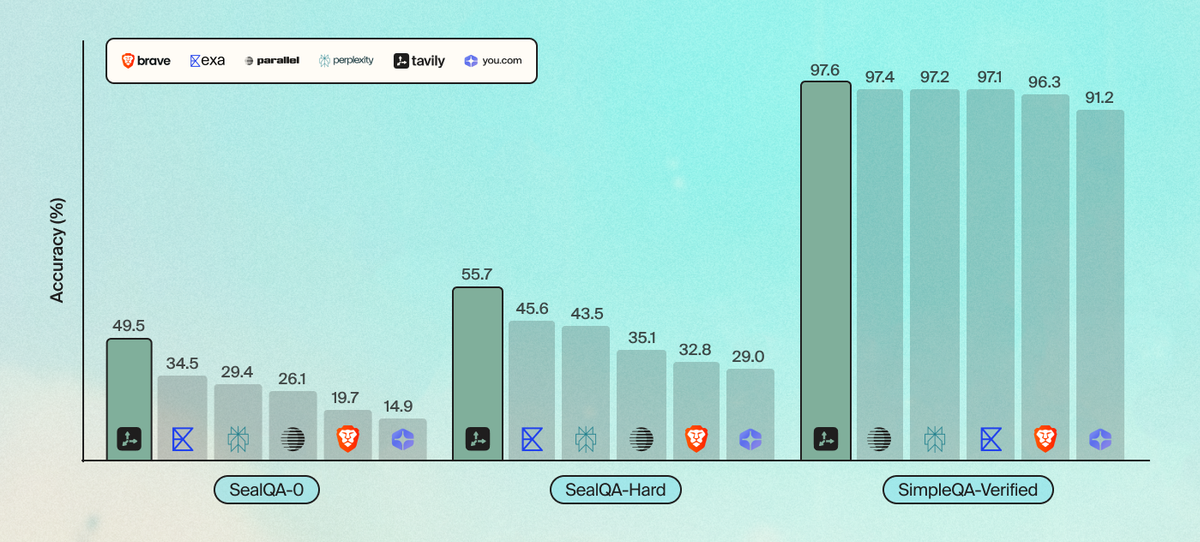
Over the past several months, we've overhauled core parts of our search system: reranking and evidence-quality modeling, evidence deduplication and contradiction handling, and index coverage and temporal freshness. The results: Tavily now ranks #1 on both SealQA-Hard and SealQA-0, outperforming Exa Auto, Parallel Advanced, Perplexity Search, Brave, and You.com. We also topped SimpleQA Verified, though if you're building agents, SealQA is the benchmark worth paying attention to. More on that below.
Why SealQA?
SimpleQA has overly straightforward, factual questions that are far from real-world agentic search (ranked #1 there too). BrowseComp is at the other extreme. It is so agentic that it hides the actual search quality behind the harness. SealQA strikes the balance: it targets more complex queries while still revealing the underlying search quality in a single step.
What was improved?
These gains reflect several months of targeted engineering work across three components of the retrieval pipeline:
- Reranking and evidence-quality modeling: We substantially improved the post-retrieval scoring functions that rank both sources and the evidence extracted from them. Tavily has long optimized not only for retrieving authoritative, relevant pages, but for identifying the evidence most likely to answer a query. The latest improvements refine how source authority, credibility, query relevance, and evidence quality are weighted together. This is especially important for agentic search: traditional web search helps humans find the right page, while machine-oriented search must also surface the right evidence from that page.
- Evidence deduplication and contradiction handling: We improved how the system identifies semantically redundant, overlapping, and potentially conflicting snippets. Reducing repeated or inconsistent evidence increases the information density in the retrieved context and lowers the likelihood that downstream models hedge, overgeneralize, or produce unsupported conclusions.
- Index coverage and temporal freshness: We expanded index coverage and improved update responsiveness for rapidly evolving topics. This reduce evidence gaps and the retrieval of stale information, particularly for time-sensitive queries where source recency is a critical relevance signal.
Evaluation methodology
We wanted to measure the pure search quality, not hidden behind a complex harness or improved through multiple agentic steps. So, we kept the pipeline short and simple:
- Query each provider's Search API with max_results=10
- Pass the returned snippets to a reader model (Summarize the answer using gpt-5.4 Mini with reasoning_effort=“medium”)
- Grade the extracted answer using gpt-4.1-mini with the official SealQA grading prompt, adapted from the original SealQA paper
Across all providers, reader model, grader model, prompts, and retrieval budget were identical. The only variable is what each provider returns, which is exactly what we wanted to measure.
Why this matters
Language models keep getting better at reasoning. Which means, the limiting factor isn't the model, but the quality of the information it receives. Every improvement we've made to Tavily Search starts from the same question: does this help an agent retrieve better evidence and produce a more accurate answer?
We're glad to see that question answered so positively in SealQA. That said, we treat any benchmark as one signal. And we know that no public benchmark can represent your needs better than your end-users. If your team is building agents, we encourage you to run evaluations using queries from your own real-world use cases to see how they perform.
How to test out the Tavily improvements
Search improvements across our API, SDKs, CLI, and MCP server are already live for all Tavily users. Start building here.