
/Company11 min read
How Tavily Uses Tavily in Sales: Finding and Reaching Customers
This blog highlights how the Tavily GTM team is using live web research through Tavily to understand our market, choose the right accounts, and give reps relevant information they can use to start genuine conversations.

A developer signs up for Tavily.
They could be testing a side project on a Saturday, or they could be the first person at a large company prototyping a product that will eventually make millions of web searches. From the signup alone, it’s hard to tell the difference.
The same visibility problem shows up everywhere else in sales, too:
A company lands in a Clay table. We know its size, industry, location, and funding, but we don’t know what it’s building.
A rep opens the dialer. They have a name, title, and phone number, but the rep still doesn’t know why that person would or should want to talk to us.
A meeting appears on the calendar. The company summary for the attendee is in the meeting details, but what’s recently changed at the company isn’t.
That’s the problem I work on at Tavily while supporting sellers, SDRs, FDEs, and execs. I’ve found that most of the work comes back to answering three questions:
- Which companies should we pay attention to?
- What is happening there right now?
- Is there anything useful for us to do?
A signup or company record can tell us who an account is, but it can’t tell us whether the company is building something that might need Tavily.
That context can and does appear in public sources: product pages, documentation, job posts, GitHub repositories, and launch announcements. When looked at together, those sources can reveal what a company is building, whether it depends on current information from the web, and whether anything has changed recently.
Using Tavily in our sales workflows
At Tavily, our sales team has grown more than 4x this year, and with a goal of helping every rep book 50% more new business meetings, we’re focusing on fewer, but better-fit accounts.
Reaching it depends on knowing where to start. Which signup is a weekend project? Which is the first sign of a real project? Which company has a genuine reason to talk to us now?
These five workflows support everything that happens before the conversation: enriching and prioritizing accounts, identifying the right reason to reach out, and preparing reps for their meetings.
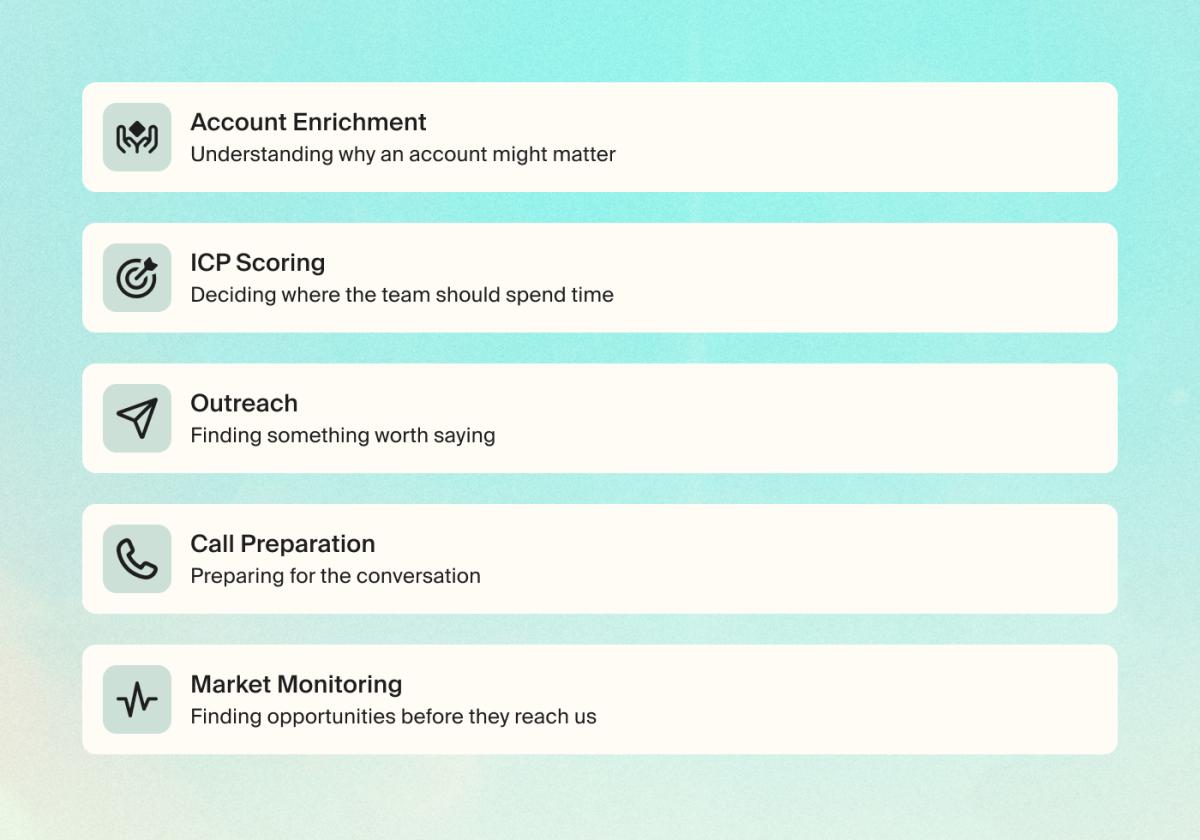
Each researches the web for the decision in front of it, returns the sources behind its findings, and gives someone on the team the context to decide what to do next.
1. Account enrichment: Understanding why an account might matter
The usual account record gives us a description of the company:
500 employees · Financial services · Series C
That context matters, but does it tell us why the company might need Tavily? No.
For that, we need to know what’s happening inside the business. A more useful account description might look like this:
The company launched an investment research assistant, is hiring an applied AI engineer, and cites outside sources in its product.
Now you have something to investigate. Their team may need reliable web search, and you see several public signals supporting that idea.
This workflow can begin when a developer signs up, an SDR adds an account, a company enters Clay, or product usage crosses a meaningful threshold. In our case, Tavily researches what the company is building, whether the product depends on current information, what’s changed recently, and which people appear closest to the work.
And because results from Tavily are meant to be checked rather than accepted blindly, each finding comes with a source.
In our workflow, we use Clay to combine this research with product activity and standard company data. The output helps us decide whether the account deserves a closer look.
The research also needs to understand meaning, not just match keywords. One company calls its product an agent. Another calls it an assistant, copilot, or research platform. A documentation page may never say “agent”, but still describe a product that searches the web and returns cited answers.
The question we want this workflow to answer is straightforward
Why might this company need Tavily?
If the research can’t give us a credible answer, that’s useful too. We can move on instead of asking a rep to manufacture a reason and waste time chasing it.
Over time, we’re comparing accounts with clear, sourced use cases against accounts chosen from standard company data. We’re tracking whether the research helps us find accounts that book meetings and become opportunities. Doing so helps tighten the criteria we use in search.
2. ICP scoring: Deciding where the team should spend time
Finding a plausible use case is only the first step. A company can be a strong fit for Tavily, but still have no reason to talk today.
That’s why our scoring workflow looks at three different things: fit, timing, and activity.
Fit asks whether the company appears to have a real need for current information from the web. We look for products that answer questions using up-to-date information, documentation that mentions outside sources, and teams building search or retrieval infrastructure.
Timing asks whether something has happened recently that makes the need more important. A company may have launched an agent, hired a Head of AI, opened a Reinforcement Learning role, or changed its product documentation. A funding announcement on its own is not enough, and neither is a job post from eighteen months ago.
Activity comes from our own product. Is someone at the company already using Tavily? Do we have any context on their use case? Which part of the company do they appear to belong to?
Together, those signals help us decide where an account should go.
Once an account scores high enough, we identify the right people and add them to the appropriate outreach cadence. If the company looks promising but there isn’t a good reason to contact them yet, the account stays in a monitoring workflow. The agent continues checking for changes and flags the account when the timing is right.
Some accounts go nowhere and that's okay. Prioritizing makes the list smaller, but gives the team more confidence in, and time to nurture, what remains.
3. Outreach: Finding something worth saying
AI made it easy to write a cold email, but it’s not an email that anyone wants to read. The difficult part still happens before the draft: finding a credible reason the person on the other end might care.
Our outreach workflow starts there. It looks for a real connection between what the company is doing and what Tavily provides. That could be a new agent product, documentation that depends on current sources, a relevant technical initiative, or existing Tavily usage connected to a larger company project.
Only after finding that connection does the workflow help with the message.
Consider the difference between these two openings:
Congratulations on your recent AI launch.
And:
I saw in your launch post that the next version of your research assistant will incorporate live market information. Are you evaluating web-search infrastructure for that?
The first could have been sent to almost anyone. The second gives us something specific to discuss and points back to real information.
The same research can help with an email, a call opener, a LinkedIn message, or a note for the account owner. It can also tell us if there’s no good reason to reach out.
There are times when the connection comes back as weak, or old, or we’d be forcing a story that doesn’t sound genuine if we chose to engage. In those cases, we would rather send nothing.
Then, when it comes to judging the performance of these workflows, we look at positive replies, connected calls, meetings booked, and the opportunities created from those meetings, rather than by how many messages it can generate.
4. Call preparation: Preparing for the conversation
Once a call or meeting is scheduled, the research question changes. The rep no longer needs to know whether the company belongs on a list. They now need context to have a useful conversation.
A standard company summary rarely gets them there. Knowing when the business was founded or how much it raised does not help much when someone answers the phone. The useful details tend to be more specific: what the company is building, what changed recently, who the rep is speaking with, where Tavily might fit, and what still needs to be learned.
Tavily researches those questions across product documentation, LinkedIn activity, job posts, interviews, GitHub, and launch announcements. The result is a short brief that can appear in the dialer, Slack, or a meeting-prep document.
It might look like this:
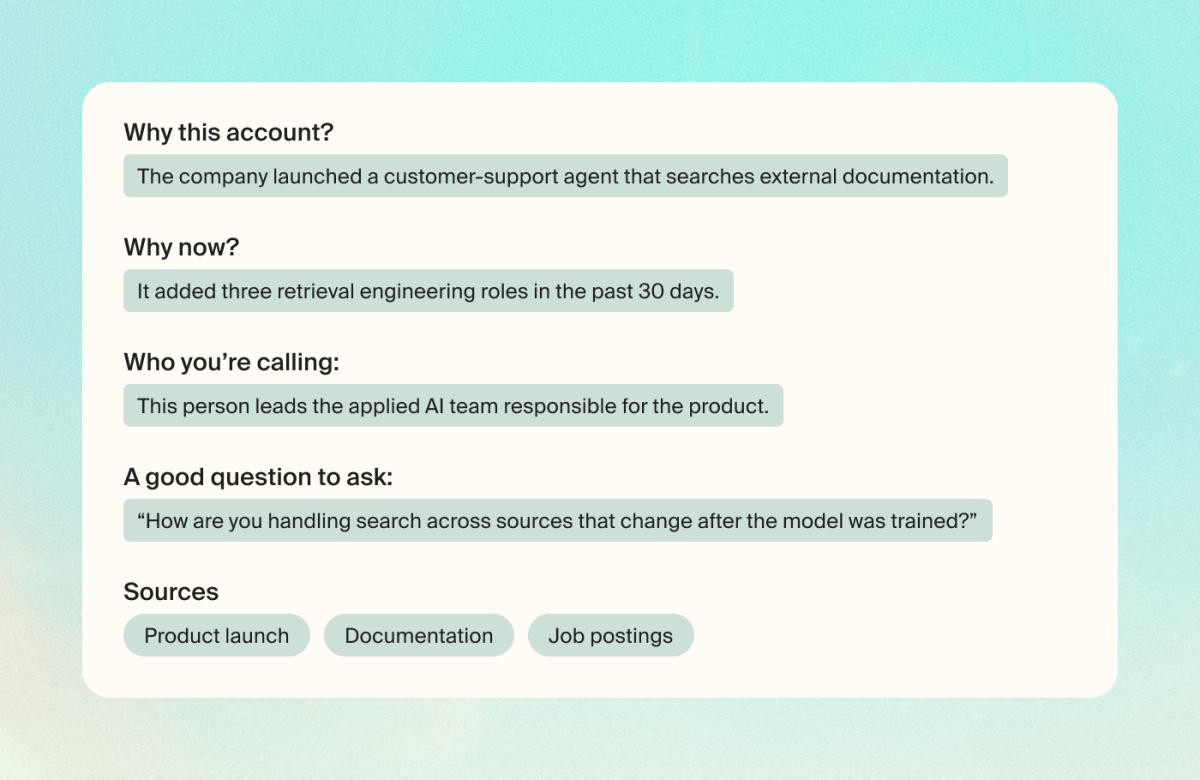
The brief is not intended to script the conversation or pretend we already know what’s happening inside the company. It gives the rep a reasonable hypothesis, a question to test it with, and the sources to inspect beforehand.
Saving research time is helpful, but it is not the full measure of success. The more important question is whether better-prepared calls turn into more meetings and whether those meetings become real opportunities.
5. Market monitoring: Finding opportunities before they reach us
Not every relevant company begins as a signup or form fill.
A new feature may appear in the documentation before the company announces it. A team may open several retrieval roles months before launching a product. A technical leader may describe an initiative in an interview long before it reaches the homepage.
Our monitoring workflow looks for those changes across the companies, products, and topics that matter to Tavily. There’s always more news, more content, and more noise. The useful work is deciding whether something is actually new, whether it matters to us, and whether anyone should do something about it.
A monitoring system that forwards every piece of news is just another feed people learn to ignore. The outcome we care about is whether the workflow finds companies and changes that we can turn into qualified accounts, meetings, opportunities, and eventually pipeline.
When the research is wrong
It will be wrong sometimes. Company names are ambiguous, product language changes, sources repeat one another, and a recent signal can be irrelevant.
That’s why every workflow from Tavily returns the source behind its findings. If it identifies the wrong company or relies too heavily on an old page, the rep can see where the answer came from.
We also pay attention when our reps stop using the output. If they keep seeing old, irrelevant, or incorrect findings, they lose trust quickly. Once that happens, it doesn’t matter how sophisticated the workflow is.
The standard is not perfection. It’s showing the work, making the answer easy to check, and getting better when the research misses.
Finding the first workflow to build
At your next sales meeting, ask a rep to open one account they plan to contact that day.
Give them two minutes to answer:
- What is this company building that could require our product?
- Why is it worth contacting them now?
- What public source supports that conclusion?
If they cannot answer all three, look at where they got stuck:
- Don’t know what the company is building: Start with account enrichment.
- Know it is a fit, but not why now: Start with market monitoring.
- Know why it matters, but not what to say: Start with outreach research.
- Have a meeting, but lack useful context: Start with call preparation.
Repeat this with a few accounts. The question your team struggles to answer most often is the workflow to build first.
The goal is not to automate everything, it’s to find the point where missing research is making it harder for your team to decide what to do next.
Closing thoughts
A typical enterprise SaaS seller carrying a quota of $1 million or more needs over $3 million in pipeline to maintain 3x coverage. Our sales team has grown more than 4x, and we’re building for every rep to reach 150% of their new-business meeting target.
At that scale, every weak decision multiplies. We cannot ask the team to work four times as many accounts or spend four times as long researching them.
We have to get better at deciding where to spend that time.
That’s how we use Tavily to find the companies that need Tavily. It researches what companies are building, what has changed, and where there may be a real reason to engage. Then our team decides what to do next.
Want to try it on your own sales workflow? Try Tavily for free.