
/News3 min read
Building at LangChain Interrupt with Tavily and Nebius
At LangChain Interrupt, we demoed an agent that uses Tavily for real-time search and Nebius for scalable inference to continuously gather, verify, and structure competitive intelligence.

At LangChain Interrupt this year, we demoed a competitive intelligence agent built with LangChain Fleet, Tavily, and Nebius Token Factory.
The goal is to create a system that can continuously research competitors, structure insights, and keep teams up to date in real time without requiring them to leave the tools they already use.
From Search to Agentic Intelligence
Competitive intelligence has traditionally been a manual workflow. You search the web, read through results, synthesize findings, and update internal docs. Then you repeat the process a few days later because everything has already changed.
This is the perfect opportunity for something more agentic, a system that can plan, research, and synthesize across multiple steps.
System Overview
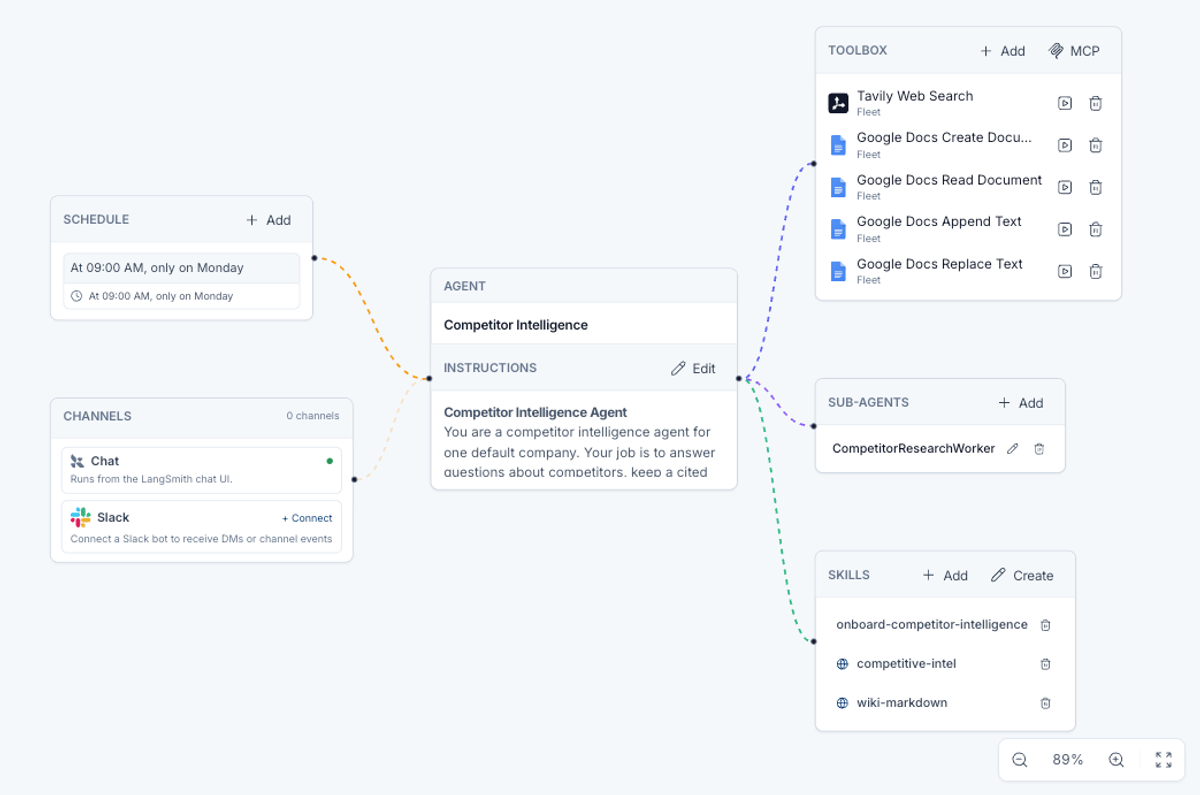
Competitor Research Subagent
The unit of work is a single subagent we call the CompetitorResearchWorker. Each invocation handles exactly one competitor and returns a cited markdown that the parent agent merges into the wiki and battlecard.
Scoping the worker tightly to one competitor per run is intentional. It keeps the context window predictable, makes the outputs comparable across runs, and gives the orchestrator the ability to research all competitors in parallel.
If no meaningful update is found, the worker says so directly and lists the searches and sources it checked. We'd rather have a clean "nothing new" than a hallucinated update.
Nebius Token Factory Inference
Nebius was at Interrupt too, showing off how the workers run on Nebius Token Factory. What made Token Factory the natural choice for this workload was the combination of production-latency open-source models, reliable tool calling and reasoning support on cheaper tiers, and predictable per-token pricing.
That combination is important for agentic workloads. The worker does not need frontier-coding-level capability; it needs reliable tool calls, long context, structured synthesis, and predictable costs. Nvidia Nemotron handled the loop well: plan searches, call Tavily, read snippets, and write cited markdown without drifting from the format.
A profiled run used 409.4K tokens and took about 3 minutes. On Claude Opus 4.7, that would cost about $2.16. On Nemotron-3-Super, it cost about $0.13, roughly a 17× reduction per invocation.
Tavily Across Interrupt Workshops
While our demo focused on competitive intelligence, we showed up in different ways across many workshops at Interrupt: teams consistently reached for Tavily when they needed reliable, real-time web context inside their agents.
Whether the use case was research assistants, coding copilots, or domain-specific agents, search was almost always the first step in the chain. Before an agent could act it needed fresh, grounded information, and that’s where Tavily came in.
In workshop after workshop, builders used Tavily to:
- Pull in up-to-date documentation, changelogs, and APIs for coding agents
- Gather external context for research and analysis workflows
- Verify claims and reduce hallucinations with cited sources
- Bootstrap multi-step agent loops that start with retrieval and end with structured outputs
Where Else?
It wasn’t just the show floor and workshops for Tavily and Nebius. We cohosted a couple events with Arcade.dev and CopilotKit that saw builders and business leaders from across industries get together to talk shop.
At our dinner with Arcade.dev, AI business leaders joined us for a deeper conversation on what it actually takes to move agentic systems from prototype to production. The discussion centered on the real challenges teams are facing, scaling beyond proof of concept and turning early experimentation into measurable impact.
And at our Agents After Dark event with CopilotKit and Nebius where the night brought together the teams behind the infrastructure powering many of today’s agentic systems, from Tavily’sreal-time web intelligence layer, to CopilotKit’s agentic frontend stack, to Nebius’ full-stack AI cloud platform.
Are you interested in building agents with Tavily and Nebius Token Factory? You could head over to LangChain Fleet and get started today.