
/Company6 min read
Accept, Accept, Accept: How AI Is Choosing Your Tech Stack
I've been watching tech stack decisions happen inside Cursor and Claude lately. No website visit, no docs rabbit hole, just a few "accept" clicks and the tool is in the codebase. As someone who came up as a developer and data scientist, this isn't how I used to evaluate anything. Here's what I think it means for fellow dev tool companies.

Your next customer isn’t a developer. It’s their AI coding assistant.
I’ve been building developer tools for years. And I’m here to tell you: everything we knew about go-to-market is being rewritten right now.
Not incrementally. Fundamentally.
The shift isn’t just about product-led growth replacing sales-led growth. It’s about a completely new actor entering the buying process — one that’s making technology decisions at a scale and speed we’ve never seen before.
That actor is the AI coding assistant.
The Three Eras of Developer Tools GTM
Let me give you the 30-second history of how developer tools have been sold:
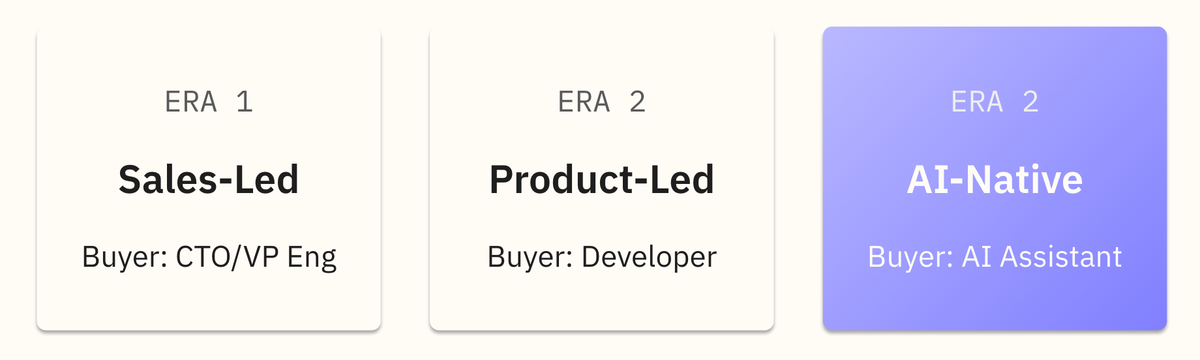
Era 1: Sales-Led (1990s–2010s) — Enterprise sales teams sold to executives. Developers were users, not buyers. Success meant winning RFPs and navigating procurement.
Era 2: Product-Led (2010s–2023) — The consumerization of enterprise software. Developers gained budget authority. Success meant great onboarding, freemium tiers, and viral loops. Companies like Stripe, Twilio, and Datadog wrote this playbook.
Era 3: AI-Native (2024+) — This is where it gets interesting. AI coding assistants are now the de facto gatekeepers of the tech stack. And most developer tool companies haven’t realized it yet.
The “Accept, Accept, Accept” Problem
Here’s what’s actually happening in codebases right now:
A developer opens Claude Code, Cursor, or GitHub Copilot. They describe what they want to build. The AI suggests an implementation — including which libraries, APIs, and services to use.
The developer reviews. Clicks accept. Accept. Accept.
In that moment, a technology decision was made. But the developer didn’t make it — the AI did.
The AI coding assistant is becoming the most influential “developer” in your funnel. And you’re probably not marketing to it at all.
Think about the implications:
Your beautiful landing page? The AI never sees it. Your carefully crafted onboarding flow? Skipped entirely. Your developer advocates at conferences? The AI wasn’t in the audience. Your SEO‑optimized documentation? Only useful if the AI’s training data happened to include it. In this new reality, much of what traditional developer marketing relies on is simply invisible to the actual decision-maker.
The traditional funnel — awareness → consideration → conversion — is being compressed into a single AI-mediated moment. The AI is aware of tools, considers them, and converts (by suggesting them) all within one autocomplete.
Why This Changes Everything
Let me be concrete about what this shift means for GTM:
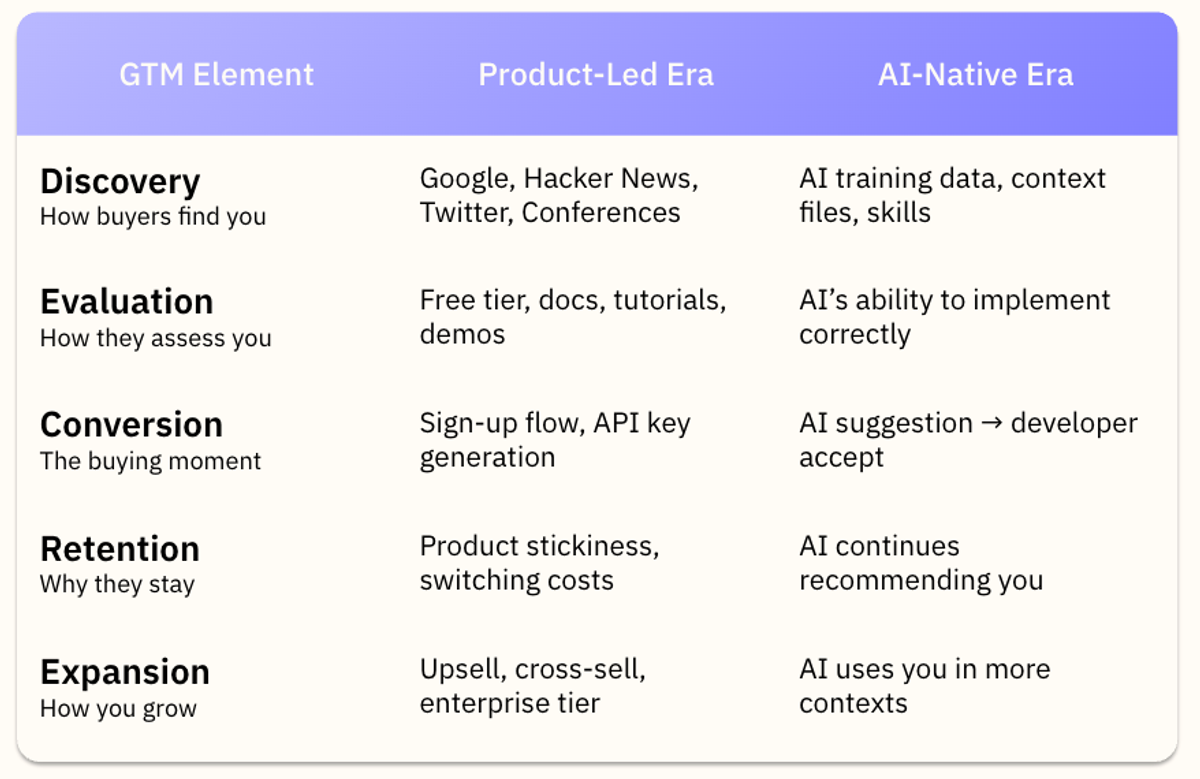
The companies that win in this era won’t just have great products. They’ll be the tools that AI coding assistants know best and recommend first.
The New GTM Stack: AI-Native Distribution
So what do you actually do about this? Here’s the playbook we’re developing at Tavily — and what I’d recommend to any developer tools company:
1. Penetrate the Context Layer
AI coding assistants don’t operate in a vacuum. They read context from the project they’re working in. The most important piece of real estate is now the CLAUDE.md file (or equivalent context files for other assistants).
If your tool has a presence in CLAUDE.md, the AI will consider it whenever a relevant problem comes up. If you’re not there, you don’t exist — regardless of how good your landing page is.
This means your GTM strategy needs to include:
- Documentation that’s context-file friendly — clear, structured, and easy for developers to paste into their project context
- Templates and snippets that developers naturally add to their CLAUDE.md
- Best practices guides that position your tool as the default choice for specific use cases
2. Build AI-Native Skills and Plugins
Beyond passive context, you can create active integrations. Skills and plugins make your tool a first-class citizen in the AI’s toolkit — not just something it knows about, but something it knows how to use well.
At Tavily, we’ve invested heavily in this. Our Claude skill doesn’t just let Claude call our API — it teaches Claude the optimal way to use web search in agentic workflows. The difference matters:
Without Skill: AI knows Tavily exists. Might suggest it. Implementation quality varies.
With Skill: AI knows exactly how to use Tavily effectively. Suggests it in the right contexts. Implementation is correct from the start.
This is the new moat: not just brand awareness, but implementation fluency.
3. Reduce Friction to Zero
In the AI-native era, friction is fatal. When Claude suggests a tool and the developer clicks accept, everything needs to work immediately. Any friction — complex setup, manual configuration, authentication headaches — and the developer will ask Claude for an alternative.
In practice, this means that setup must be reduced to a single command — or ideally, no explicit setup at all.
Production‑ready defaults should work out of the box without requiring manual tuning. When failures occur, error messages need to be structured and explicit enough for an AI assistant to understand and correct the issue autonomously. Documentation can no longer be written only for human readers; it must anticipate the questions an AI will ask while generating and revising code.
4. Optimize for Training Data (Carefully)
Here’s an uncomfortable truth: what’s in the AI’s training data matters more than what’s on your website today. If your tool was well-documented, widely used, and frequently discussed in tutorials and blog posts before the training cutoff, you have an advantage.
For newer tools, this means:
- Open source projects create training data surface area — our GPT Researcher project has generated thousands of tutorials, implementations, and discussions that inform how AI understands agent search patterns
- Community content compounds — every blog post, Stack Overflow answer, and GitHub issue becomes potential training data
- Ecosystem integrations matter — being in LangChain, LlamaIndex, or CrewAI documentation means being in the AI’s understanding of how tools compose
What This Looks Like in Practice
Let me walk you through the AI-native funnel for Tavily:
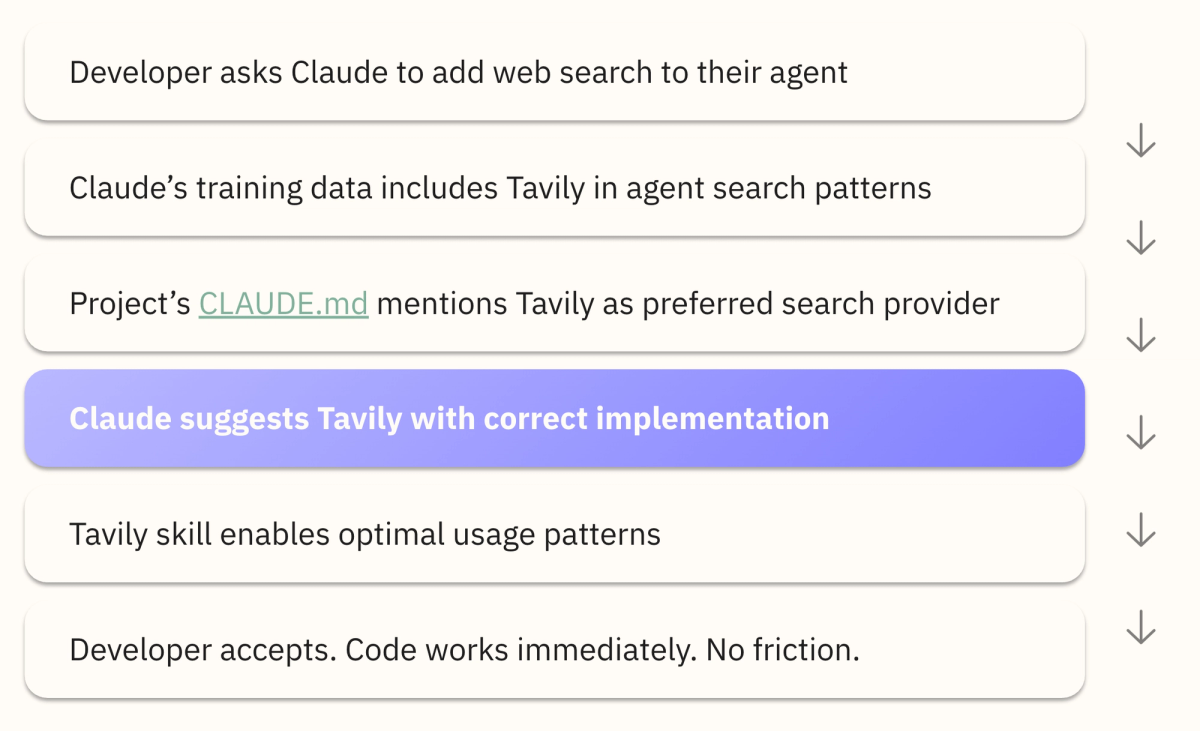
Notice what’s not in this funnel: landing pages, sign-up forms, email sequences, sales calls, or even traditional documentation browsing. The entire journey from problem to implementation happens inside the AI interaction.
The Compounding Effect
Here’s what makes AI-native distribution so powerful: it compounds in ways traditional marketing doesn’t.
Every developer who accepts the AI’s suggestion of your tool:
- Creates code that future AI training might learn from
- Might add your tool to their project’s context files
- Generates usage that reinforces the AI’s confidence in suggesting you
- Potentially writes about their experience, creating more training data surface area
It’s a flywheel, but not the traditional product-led flywheel. It’s an AI-mediated flywheel where success breeds more AI recommendations, which breeds more success.
What You Should Do Now
If you’re building developer tools, here’s my concrete advice:
Immediate Actions
- Audit your AI presence. Ask Claude, GPT-5, and other models about your category. What do they recommend? How well do they understand your tool?
- Create context-file-ready documentation. What would you want in a project’s CLAUDE.md to ensure your tool gets recommended? Write that, and make it easy for developers to add.
- Build a skill or plugin. Don’t wait. The tools that have native AI integrations now will have a compounding advantage.
- Reduce implementation friction ruthlessly. Every step between “AI suggests” and “code works” is a drop-off point.
Strategic Shifts
- Reallocate marketing spend. Traditional awareness campaigns matter less than training data surface area and AI integration quality.
- Invest in open source. Not for community goodwill (though that’s nice), but for training data presence and ecosystem integration.
- Think in terms of AI fluency. It’s not enough for AI to know your tool exists. It needs to know how to use it well.
The Bottom Line
We’re at an inflection point. The GTM playbooks that worked in 2020 — or even 2023 — are becoming obsolete faster than most people realize.
The developer isn’t going away. But their workflow is changing fundamentally. They’re collaborating with AI assistants that suggest, implement, and iterate at machine speed. And those AI assistants are becoming the most important “developers” in your funnel.
The question isn’t whether to adapt to AI-native distribution. The question is whether you’ll do it before your competitors do. The tools that win the next era will be the tools that AI knows how to use — and recommends first.
The playbook is being rewritten. Make sure you’re writing part of it.
We’re hosting a live session to break it down further, join us on February 12. https://www.tavily.com/webinars